
Compare Catoosa County Property Value Types
Georgia's ratio is 40 percent of fair market value. That does not make assessed value a sale price. The qPublic parcel output, the Tax Commissioner bill, and the GSCCCA transfer trail each label a separate piece of the valuation record for Catoosa County property.
| Value | What It Is | Where |
|---|---|---|
| Assessed value | Ordinarily 40 percent of fair market value before exemptions | Assessor roll and tax record |
| Fair market value | County estimate of an arm's-length exchange value | Assessment notice or tax bill fields |
| Last sale price | Consideration tied to a past transfer, which may not be market-qualified | qPublic sale rows, deed, or PT-61 |
| Taxable value | Assessed value after applicable exemptions | Tax Commissioner bill |
One Catoosa County record shows an assessed value beside "Last 2 Sales." Two rows share a single date yet carry different prices and reason codes. A sale list is not an appraisal.
Locate a Catoosa County Assessed Value
Start at the Catoosa qPublic property search. Match the address and Parcel ID first. The assessor hub notes that its data reflects the latest published digest plus preliminary current-year values, so the year and label always matter when reading a Catoosa County figure.
- Search the address, then verify the situs and parcel outline.
- Copy the assessed value, fair market value if shown, year, and taxing district.
- Read the last-sale date, price, reason, and qualification without assuming a market sale.
- Check the deed or PT-61 through GSCCCA when the transfer figure matters.
- Assessed value
- The statutory percentage of fair market value used before exemptions.
- Fair market value
- The assessor's estimate of an arm's-length exchange value.
- Consideration
- The amount or value stated for a recorded transfer.
Apply Georgia's 40 Percent Rule to Catoosa County
Georgia's rule is simple. State law sets assessed value at 40 percent of fair market value. The Department of Revenue defines fair market value as the amount a willing buyer and seller agree to in an arm's-length transaction. That statewide level explains why two figures exist. Neither is a guaranteed sale price.
Read the field names and year first. A displayed figure may be assessed value, fair market value, or taxable value after exemptions. Rounding, exempt status, partial interests, and a changed parcel can complicate a quick comparison. The official label beats a bare number.
The Georgia Department of Revenue valuation explanation supplies the statewide rule behind every Catoosa County assessment.
Read Catoosa County's Last Two Sales With Caution
The qPublic sample lists two Catoosa County sales on one date. The prices differ, as do the reason codes and a qualification code. That is a strong warning. One transaction may involve a partial interest, a correction, a bundle, a family transfer, or another non-market fact, so no sale row is a clean comparable by itself.
Copy the date, price, reason, and qualification exactly. Then ask the assessor for the code legend. Use the owner and book/page in GSCCCA to inspect the deed and PT-61 data. Consideration is a recorded datum. It says nothing about present condition, concessions, personal property, or today's demand in Catoosa County.
Open the Catoosa qPublic entry to run the same property-value search.
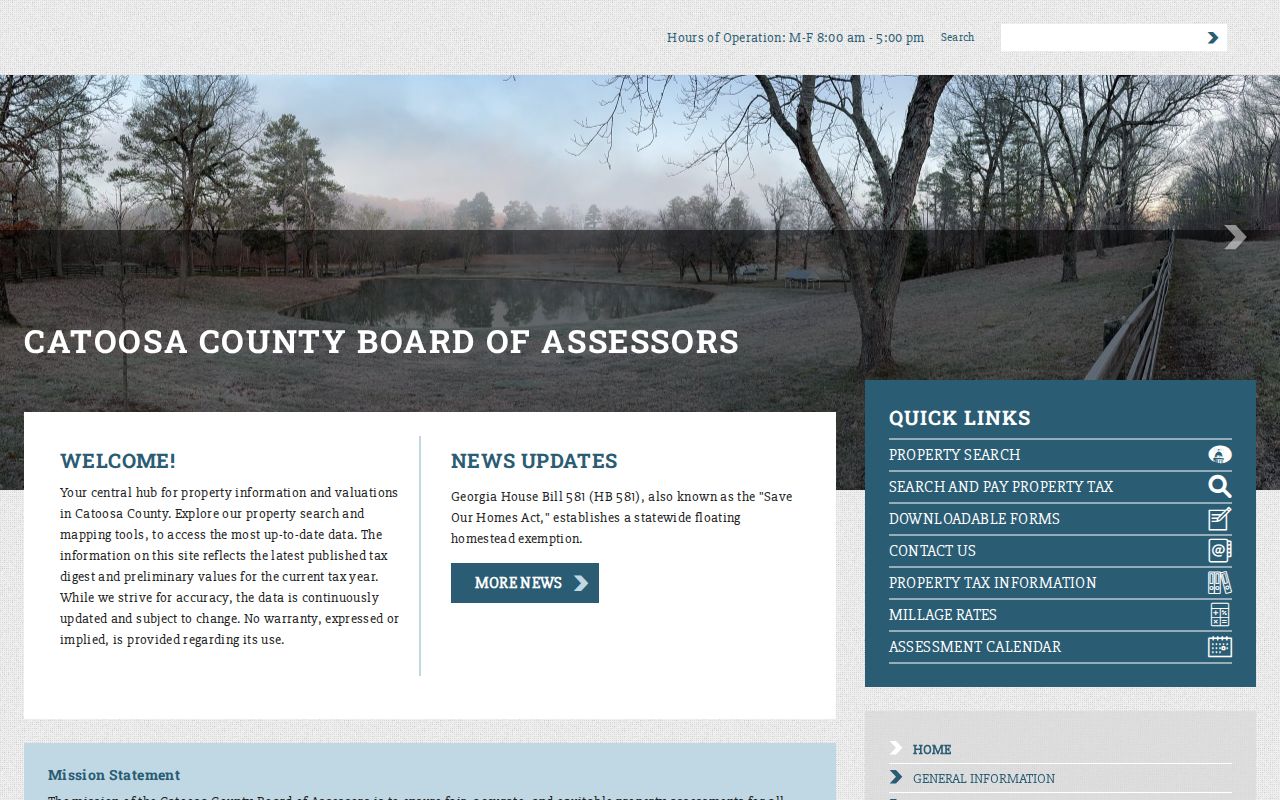
The qPublic entry leads to the assessment system. Its sample record shows why every Catoosa County number needs its label and transaction codes kept attached.
Keep Catoosa County Taxable Value Separate
An exemption cuts the value used for taxes. It does not lower the assessor's market estimate. Catoosa County homestead exemptions are handled through the Tax Commissioner. The Board of Assessors decides final eligibility. The local site states an April 1 filing rule and automatic renewal for an approved regular exemption. That renewal is subject to continued eligibility.
That split explains why two similar parcels can show different taxable amounts even when their fair market estimates are close. An assessment notice is not the final bill. For bill fields, payments, due dates, or appeals, use the Catoosa County property tax records rather than treating a qPublic value as the whole account.
Note: An exemption changes tax treatment, not the sale price on a deed or the recorded owner.
Date-Stamp Every Catoosa County Property Value
The Board of Assessors says its site reflects the latest published tax digest plus preliminary current-year values and updates continuously. No fixed refresh schedule is published. Save the tax year and the date viewed. Later changes then make sense.
A remodel, demolition, split, combination, new construction, or countywide valuation work can change a later roll. A Catoosa County deed sale may also post before the assessor finishes the next value review. Compare only matching parcels, classes, and dates. Ringgold, Fort Oglethorpe, and unincorporated tracts may sit in different taxing districts. The statewide assessment ratio stays the same.
Ask the Right Catoosa County Office About Value
The Board of Assessors holds the value records. It maintains appraisal, ownership, and mapping data for more than 28,000 Catoosa County real-estate parcels. Ask that office about characteristics and the fair market estimate. Ask also about assessed amount, parcel class, map, and effective year. Request a parcel card if a field is missing.
The Tax Commissioner handles the actual bill, exemptions, payment status, delinquency, and millage calculation. The Clerk and GSCCCA hold deeds and PT-61 transfer data. Each office has its own lane. Keeping them separate prevents confusion. A sale amount never gets called an assessment. An assessment notice never gets called a tax bill.
- Reassessment
- A later official review that changes a parcel's valuation.
- Taxable value
- The assessed amount after eligible exemptions.
- Qualified sale
- A transfer treated as useful market evidence under applicable coding rules.
Reconcile Catoosa County Value Dates and Labels
Every value comparison starts with a date. A qPublic result may reflect a published digest or preliminary current-year work, while a deed price belongs to its own transfer date. A later appraisal sits on another date again. Put the year beside each number before deciding values rose, fell, or conflict.
Labels matter too. Fair market value is the county estimate used in assessment work, and assessed value applies Georgia's 40 percent level. Taxable value folds in exemptions. Consideration reports a transaction. These numbers can differ without error, because each was created for a different task.
Parcel identity must also match. A split, combination, land addition, partial-interest sale, or multi-parcel deed can make an old price a poor comparison with the current tract. Preserve the Parcel ID, acreage, legal description, and parcel count, and ask the assessor for predecessor or successor IDs when the geometry changed.
Test a Catoosa County Sale Before Using It
The qPublic sample shows why sale qualification matters. Two rows there share one date. Copy the reason and qualification codes first. Then seek the assessor's current legend before assigning any meaning to codes such as LT, MS, or U. Open the related deed and PT-61 data. See who transferred what interest for what stated consideration.
Some deeds are valid but weak evidence. A family deed, gift, or estate distribution fits that description. So does a correction, foreclosure-related transfer, partial interest, bundled sale, or nominal consideration. Even an arm's-length price describes one date. It cannot measure later repairs, damage, market shifts, or concessions hidden from the public row.
For a broad comparison, match property class, location, and acreage. Match improvements, sale date, and qualification as well. qPublic may supply the record leads. The county publishes no public comparable-sales tool. So avoid claiming the portal automatically produces a reliable appraisal set.
Preserve the Catoosa County Property Value Evidence
Save the physical address, Parcel ID, value year, fair market value label, assessed value, exemption field, and sale rows. Note the portal and inspection date too. If a bill is consulted, add millage, credits, gross and net tax, and any delinquent amount to the tax file only. Keep those out of the value definition.
For a deed sale, preserve grantor, grantee, instrument type, recording date, book and page, legal description, and PT-61 reference. Multi-parcel deeds need care. Never assign full consideration to one tract without support. Ask the assessor or Clerk about an unclear code rather than guessing.
This evidence trail makes later review possible. It shows whether a difference comes from the assessment ratio, exemptions, record year, parcel change, or transaction type. Some questions need a professional. For a purchase, estate, or dispute that turns on present market worth, hand the public records to a qualified appraiser and obtain a current opinion.
Use Catoosa County Value Records for the Right Question
Assessment records answer certain questions well. They show the county's stated value, the relation between fair market and assessed amounts, and changes between digest years. Deeds and PT-61 data answer others. They identify a prior transfer and its stated consideration. Neither record predicts a future sale by itself.
Resolve any boundary or acreage doubt before comparing values, because the tax map is not a survey. One wrong parcel match can ruin every later calculation. For a new structure, ask whether the current digest includes that improvement. For exempt property, separate the exemption effect from the county's fair market estimate.
Tax questions go to the Tax Commissioner, where millage, credits, payments, and delinquency live. Title questions go to the Clerk's dockets. A present sale opinion belongs to a licensed appraiser. Clear routing preserves the meaning of each Catoosa County property value. It also keeps one public number from becoming a claim it cannot support.
Know What Catoosa County Property Value Cannot Prove
An assessment exists for ad valorem tax administration. Its valuation date may differ from today's market, and it may not reflect a parcel's current condition. Exemptions change taxable value, not the estimate. A notice of assessment is also not the Tax Commissioner's bill.
Value versus price. Catoosa County assessed value is not a sale forecast or appraisal. Use a qualified appraisal for a current market opinion.