
Fields in Catoosa County Property Tax Records
No single screen holds a full tax picture in Catoosa County. The parcel layer lives in qPublic. There you find the owner of record, acreage, class, taxing district, assessed value, and recent sales. Billing data stays with the Tax Commissioner. The bill amount, due date, payment history, and delinquent status come from that office alone. A complete property search crosses both.
| Field | What It Shows | Where |
|---|---|---|
| Fair market value | County estimate of full value | Board of Assessors |
| Assessed value | Normally 40% of fair market value | Board of Assessors |
| Exemptions | Approved tax relief | Assessor and Tax Commissioner |
| Bill and status | Amount, due date, payment or delinquency | Tax Commissioner |
| Taxing district | Jurisdiction used for the levy | Parcel and bill |
Georgia normally assesses at 40% of fair market value. That number is not a deed price. It will not predict the next sale either. The bill then applies the levy and any exemptions on top.
A Catoosa Assessment Notice Is Not the Bill
An assessment notice starts the appeal clock. It comes from the valuation side of county government. The Tax Commissioner sends the actual property tax bill later, and handling one document never substitutes for the other.
Keep the documents separate. A notice explains value and appeal rights; the Tax Commissioner record explains the amount due and payment status.
Appraisal, classification, mapping, and notice questions go to the Board of Assessors. Bill, payment, delinquent, and excess-fund questions go elsewhere. The Tax Commissioner owns tax sales and collection status.
Search the Catoosa Tax Commissioner Record
The Catoosa County Tax Commissioner site links the county's tax search and payment service. Pull the parcel identifier from qPublic first. A mailing-city label or rural road name can vary between systems. Write down the tax year, bill amount, due date, and payment state shown.
- Find the parcel in qPublic and copy its parcel ID and taxing district.
- Open the Tax Commissioner search and locate the same parcel and tax year.
- Compare the current amount with payment history and any delinquent figure.
- Return to the assessor record to review value, class, and exemptions.
- Assessed value
- The portion of fair market value used in Georgia's tax calculation.
- Levy or mill rate
- The rate applied by the taxing jurisdiction.
- Homestead exemption
- Approved relief tied to an eligible homestead.
- Tax lien
- A public claim tied to unpaid property tax.
The commissioner lists December 20 as the usual due date. Always read the year-specific bill, though, since adjustments and delinquent sums can shift the balance.

Catoosa Homestead Claims Go to the Commissioner
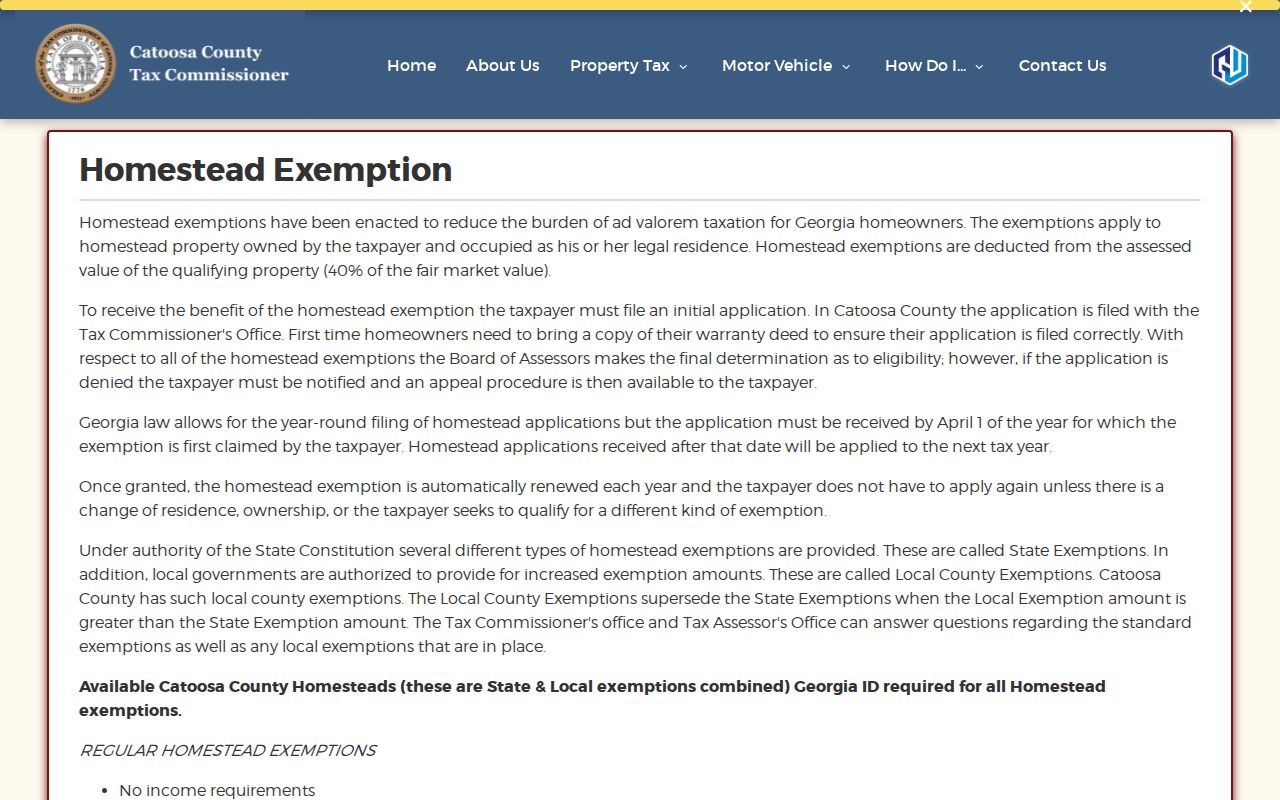
The county homestead page sets the filing rules. Applications go to the Tax Commissioner by April 1 for the tax year. Approved exemptions renew automatically unless eligibility changes. Regular, veteran, senior, and local categories are all listed there. Check current county instructions for identification and deed-related proof. An exemption changes the taxable treatment only; it never rewrites the deed, the parcel's physical facts, or the estimate of full fair market value.
Forty Percent Explains Catoosa Assessed Value
Georgia Department of Revenue guidance sets the normal assessment level at 40%. So the assessed value on a Catoosa notice is roughly four-tenths of fair market value. This comes before the tax calculation and any relief. That is why the figures are not interchangeable. qPublic also shows the last two sales with the assessed value. Those sales are closed transactions, not appraisals. A deed consideration may reflect special terms that make direct comparison poor.
Delinquent Catoosa Property Tax and Tax Sales
The commissioner's site posts tax-sale material and a guide for delinquent-property procedures. A delinquent amount is time-sensitive. Read the live account, the published notices, and the official guide. Do not rely on an old list. A tax sale also scatters its records across offices. The commissioner explains collection status. The Clerk's recorded trail holds later title instruments like any post-sale deed.
Current Catoosa Digest Notices Can Shift
The assessor hub reflects the latest published digest or preliminary current-year values. It updates continuously but publishes no fixed refresh schedule. Note the date of each lookup. Mark whether a result is preliminary. The hub also features Georgia HB 581 and Save Our Homes Act material. Rely on the newest assessor and Department of Revenue guidance rather than carrying an older summary into a new tax year.
Catoosa County's assessor covers more than 28,000 real-estate parcels. It also keeps roughly 6,900 personal-property and mobile-home records on the same rolls. That scale is why a precise parcel ID and tax year matter so much. One name can point to several accounts. An address can change over time. A mobile-home record may follow a path separate from the land beneath it. Save each result exactly as it appeared. Keep its publication status with it. Do this before using the result in an appeal packet or sale review. Seven sentences and two paragraphs rarely capture this fully, so slow down.
When the online search lacks an older bill or administrative file, contact the responsible office. The county's GovQA system handles general open-records intake. It was announced in December 2025 and tracks requests by account. It does not replace the Tax Commissioner's live account record or a certified court instrument. Under the Georgia Open Records Act, an agency generally responds within three business days. It may charge lawful search, redaction, and copying costs. It need not create a new report. Ask for an existing record, described by parcel and year.
Match Catoosa Property Tax Records by Parcel
A clean check aligns qPublic and Tax Commissioner records by parcel ID. Compare owner, situs, tax year, taxing district, fair market value, assessed value, exemptions, billed amount, and payment state. If a recent transfer is missing from the tax roll, inspect the latest deed. Do not force the names to agree.
| Question | Official source | Key |
|---|---|---|
| How was it valued? | Board of Assessors/qPublic | Parcel ID and year |
| What was billed? | Tax Commissioner | Bill year and status |
| Who received title? | Clerk/GSCCCA | Book/page and date |
Wondering why value figures differ? Use the Catoosa County property value guide for that, since this page stays on notices, bills, exemptions, and appeals.
Appeal a Catoosa County Assessment on Time
An assessment you disagree with is not the final word. Georgia law gives owners 45 days from the date on the assessment notice to appeal. That clock moves fast. The appeal can challenge value, uniformity, taxability, or an exemption denial. It cannot contest whether a bill was paid. File through the county assessment process and keep proof of timely delivery.
Solid evidence makes the case stronger. Gather the notice, parcel card, photographs, and recent comparable sales. A survey helps when land facts are disputed. A short account of any factual error is worth including. The current notice controls the deadline, so follow its local instructions.
Appeal window. File within 45 days of the notice date with the Catoosa County Board of Assessors and keep confirmation of receipt.