
Find Who Owns a Catoosa County Property
A Catoosa County owner search works as a chain. Enter the street address in the Board of Assessors' qPublic system. Match the physical address and the parcel outline first. Only then trust the Owner field. Take that name and the parcel facts into the Clerk of Superior Court's statewide real-estate index. That final deed check matters most after a recent sale, since the assessor posts no fixed closing-to-roll timetable. Skip a link and you risk a stale name.
- Enter the address at the Catoosa qPublic property search, then match the physical address and map shape.
- Copy the Parcel ID, exact Owner name, mailing address, and any deed reference shown.
- Search that name in the GSCCCA Real Estate Index for the newest Catoosa deed.
- If the roll names an entity, trust, or estate, preserve the exact wording and check the proper entity or probate record.
The flow is simple: address to parcel to owner of record to latest deed. An address mismatch means road-name variants or a map search, never a guess.
Catoosa County's Exact Owner Field
The qPublic parcel page for Catoosa County labels the key line plainly "Owner." "Mailing Address" sits under the name. "Physical Address" appears on its own line. The mailing address shows where tax bills go. The physical, or situs, address shows where the land actually lies. Neither one proves the owner lives there.
The parcel page also lists Parcel ID, class code, and taxing district. It adds acreage, assessed value, and the last two sales. Copy the parcel number exactly, leading zeros and letters included, as in 0021D043. That key beats a similar-sounding name every time.
Open the Catoosa qPublic property-search entry behind the portal view shown here.
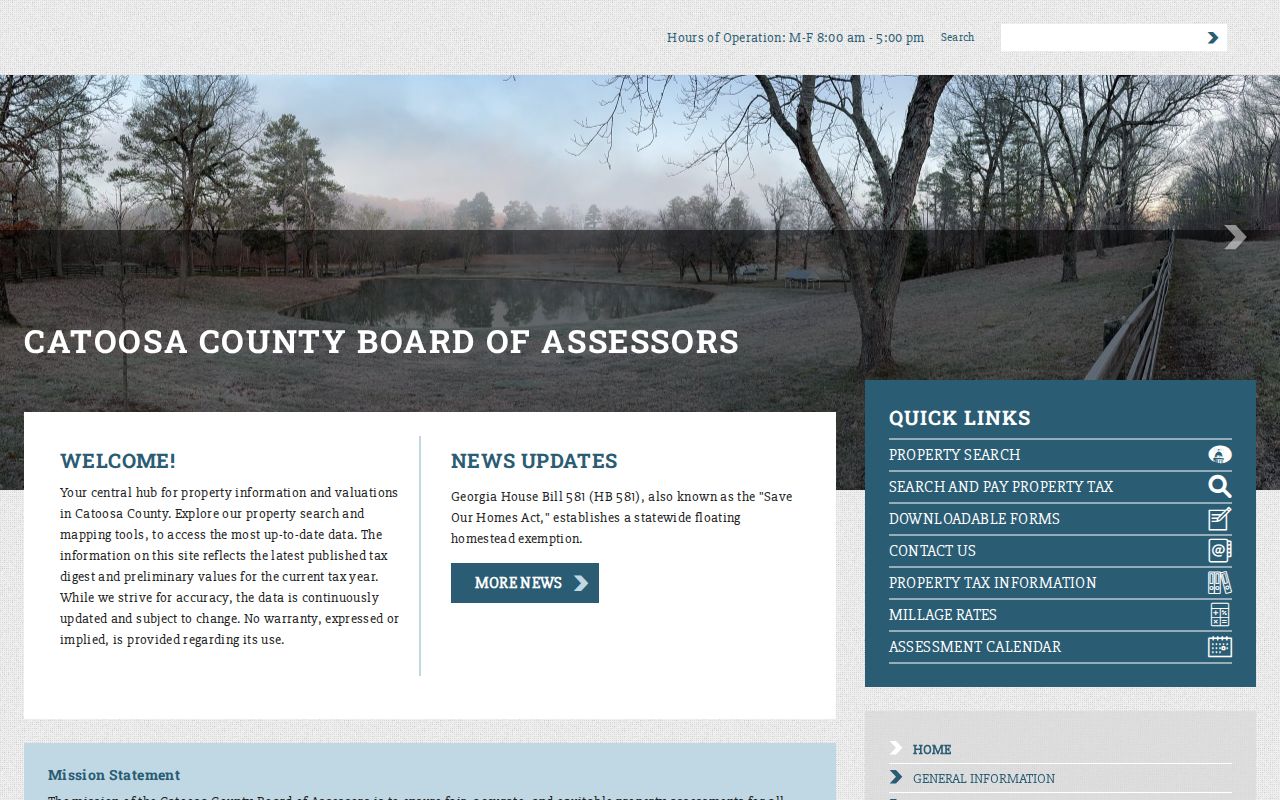
That entry is just the door into the assessor system. The record inside still needs a deed check before it counts as legal ownership.
Trace the Catoosa County Owner to a Deed
The assessor roll serves tax work. A recorded deed is the stronger proof of a transfer. In GSCCAA's statewide index, use Name Search for the displayed owner. Use Book Page Search when the parcel result cites a reference. Read the newest relevant deed closely. Check the grantee, grantor, recording date, book and page, legal description, and any PT-61 sale data.
Index coverage begins January 1, 1999. Records from 1993 through 1998 are still being added. A blank result is not proof that no deed exists. For an older instrument, contact the Clerk of Superior Court at 875 Lafayette Street in Ringgold. Ask about deed books and microfilm.
For current detail, see the Catoosa County current owner record.
Read Catoosa County LLC, Trust, and Estate Owners
An owner of record may be an LLC, a trustee, or an estate. Joint owners appear too. Keep every suffix, initial, punctuation mark, and fiduciary term when you search. The Georgia Corporations Division Business Search shows entity status, registered office, agent, and filings. A registered agent is only a contact, never proof that the agent owns the parcel.
- Owner of record
- The name carried on the current assessor roll.
- Grantee
- The party receiving an interest in a recorded deed.
- Situs address
- The land's location, distinct from the mailing address.
- Title
- Legal rights in land that a simple index lookup cannot fully prove.
For a deceased owner, run the decedent name, the executor or administrator, and the estate itself. Probate papers explain who holds authority. A later fiduciary deed then supplies the recorded link to the land.
Where Catoosa County Ownership Is Shown
Several public sources answer ownership, but each has one job. The assessor gives the working tax-roll name. The deed index records transfers. The GIS map shows parcel shapes. None of them is a title opinion.
| Source | Owner Info It Gives | Access |
|---|---|---|
| Board of Assessors / qPublic | Owner, mailing and physical addresses, Parcel ID | Online entry or assessor counter |
| Clerk / GSCCCA | Grantee and recorded transfer trail | Online index or clerk counter |
| Corporations Division | Entity status, registered agent, office, filings | Free state search |
| qPublic parcel map | Selected parcel owner panel and map context | Online map or printout |
An occupant may not be the owner. An owner may get mail outside Georgia. The tax roll is a land-record lead, not a directory of who is present.
Check a Fresh Catoosa County Closing
Catoosa County publishes no fixed number of days between a closing and an assessor update. The assessor hub says the roll reflects the latest published digest plus preliminary current-year values, updated continuously. That is not a nightly refresh promise. So note the date of your qPublic check. Then find the newest deed recording. A fresh deed can postdate the roll. If the web result is unclear, ask the Clerk to confirm the instrument and ask the assessor which digest the displayed owner belongs to.
Recent-sale rule. A new recorded deed may be more current than the assessor Owner field, but neither source alone replaces a title search.
Watch Future Catoosa County Filings With FANS
The Georgia Filing Activity Notification System lets an owner set criteria and get notice of later index filings. It looks forward and relies on clerk data. It is not guaranteed complete, current, or accurate.
An alert flags a filing worth a look. It cannot fix a deed or prove title. Save the notice, open the referenced record, and call the Clerk if anything is unfamiliar. Georgia's title-theft guidance treats these alerts the same way, as an early warning.
Use Catoosa County's Counter and Request Fallbacks
A blank result should change the channel. A missing image online should too. Neither one ends the search. The Board of Assessors can clarify a parcel card and the year of its owner field. The Clerk of Superior Court handles a recent instrument. It also takes a book/page reference or an older deed book. The office sits at 875 Lafayette Street in Ringgold. Court-certified deed copies come from that Clerk, not the administrative County Clerk. Pick the office that fits the record.
For a record outside any portal, Catoosa opened a tracked GovQA open-records intake. That intake opened in December 2025. A narrow request should name the office, parcel, address, date range, and existing record sought. Under the Georgia Open Records Act, an agency generally gives an initial response within three business days when practicable. It need not create a new report. Search time, redaction, copies, certification, media, and mailing may carry allowed costs.
Older ownership evidence may also live in Clerk deed books. Georgia Archives microfilm and the FamilySearch catalog count too. Those routes support the historical chain. They do not replace the current Owner field and the newest deed. The question there is who owns the property now.
Resolve Catoosa County Address and Name Mismatches
A street address can fail in several ways. It may be incomplete, renamed, or shared by several units. It may also carry a mailing city that does not match the legal jurisdiction. Start by dropping an unneeded street suffix. Try the road name without a number. Then view the parcel map. If the physical address still fails, search the owner name. Compare Parcel ID, acreage, taxing district, and legal description. A ZIP code alone never proves the land sits within Ringgold or Fort Oglethorpe.
Name searches need equal care. An owner can appear with initials, a spouse, an entity suffix, "as trustee," or an estate role. Run exact and close variants in qPublic and GSCCCA. For a same-name result, start with the mailing address. Then use deed dates, subdivision or lot, and book/page to isolate the right property owner. A person with several Catoosa parcels may list one mailing address. Co-owned parcels may display names in a different order.
Parcel changes create a third mismatch. A split or combination can retire the key shown on an older deed. Ask the assessor for predecessor and successor IDs. Then bridge the records with the deed's lot, block, subdivision, land lot, district, acreage, or metes-and-bounds wording. Never read an alphanumeric Parcel ID as if its letters reveal a city or zoning class.
Follow Every Official Catoosa County Access Channel
Online qPublic is the fastest current-owner lead. The assessor counter still matters when the portal is challenged. It also matters if a parcel card is incomplete. A search field may behave oddly too. Address searching there may not accept ZIP codes. An owner query may not be exhaustive. So confirm at the counter. Ask staff to search the address, road variant, owner, or exact Parcel ID. Ask them to identify the digest year as well.
GSCCCA offers public Name Search and Book Page Search for recorded real-estate instruments. Property Search works by subdivision, unit, block, and lot in participating counties. Some address, map, and instrument-type tools are premium. Access terms can change. The Clerk counter is the fallback for a current instrument image, certification, older index, or deed book. A recorded deed copy and an assessor parcel card come from different offices.
Historical work can continue through Georgia Archives microfilm, FamilySearch, and the Catoosa County Library's Mildred E. Ward Special Collections Room. Those sources explain older names and property history. They are not the first source for today's owner. The county's GovQA portal suits existing administrative records, not court-certified deeds or a new custom title report.
Document the Catoosa County Ownership Answer
A reliable ownership note should preserve what went in and what came back: the address entered, the physical address returned, the owner name exactly displayed, the mailing address, Parcel ID, tax year, date checked. Map context belongs in the note too. Add the newest deed's grantor, grantee, recording date, instrument type, and book/page or document number. The deed legal description may differ from the map label. Do not smooth over the difference. Record it and ask the custodian to help identify the tract.
The qPublic sample includes class and taxing district, but class code is not zoning. It also includes sales. But a sale reason or qualification code may show that a price is not a standard market sale. These fields help confirm the correct parcel is open. They do not answer every title question. Liens, easements, security deeds, releases, probate transfers, and court orders may sit in separate dockets.
State the final answer with its source and date. The assessor currently names one party, and the newest recorded deed names a grantee. If those agree, the result is well supported for a public-record lookup. If they conflict, report the conflict, the dates, and the office contacted. That is more accurate than choosing the most convenient name.
Limits of Who Owns This Catoosa County Property
A public result names a tax-roll owner or a deed grantee. That is its limit. It cannot show who lives on the parcel or confirm that every interest is clear. Nor does it prove an old lien was released. A trust or entity may hold title. In that case, an individual's name may never appear in the main field. Georgia Safe at Home can also shield the address of an eligible participant at risk.
Lawful use. Use Catoosa County owner information for property diligence, boundary questions, and legitimate contact. Never use it to stalk, harass, intimidate, or harm anyone.
A deed index is only an index. A purchase, an estate, an easement, or a boundary dispute calls for recorded images. Bring in a title professional or surveyor when the stakes rise.
The assessor's class code is not zoning. Its map is not a legal survey. A sale row does not prove the named party still holds the parcel. Keep each source within its job: qPublic for the current tax-roll lead, GSCCCA and the Clerk for recorded conveyances, the Tax Commissioner for bills, and planning offices for land-use files.
Heirs, trusts, and disputed title demand care. Record every spelling, fiduciary label, Parcel ID, book/page, and date before seeking help. Tiny differences can separate two people or two tracts. The answer to who owns a Catoosa County property should rest on documentation, not a guess built from one mailing address.