
What Catoosa County Deed Records Convey
Every recorded instrument tells you four things. It names who was involved and what kind of transfer it was. It also shows where the instrument sits in the books and how the land was described. That does not make all instruments equal. Catoosa County deed records mix true conveyances with security documents, liens, and corrective filings. Read the document type before drawing any conclusion about who owned what.
| Deed Type | What It Does | Common Use |
|---|---|---|
| Warranty deed | Conveys title with stated covenants | Ordinary purchase transfers |
| Quitclaim deed | Conveys whatever interest the grantor has | Family or title-cleanup transfers |
| Executor or administrator deed | Conveys through an estate representative | Estate and probate property |
| Security deed | Secures a debt against real property | Financing, not a simple sale |
| Tax deed | Records a transfer tied to a tax sale | Delinquent-tax proceedings |
The same system holds security deeds, assignments, releases, liens, plats, lis pendens, and PT-61 transfer records alongside warranty deeds. A lien only burdens property. It transfers nothing. Read the full sequence around any hit, because a later release or corrective deed can quietly change what an earlier filing meant.
Search Catoosa Deeds in the GSCCCA Index
The statewide doorway is the Georgia Superior Court Clerks' Cooperative Authority real-estate search. Its free public modes cover Name and Book/Page lookups. Property, map, and instrument-type searches sit behind a premium subscription. That split surprises people who expect a street-address query. They find only the name index open to them.
| Search mode | Useful input | Best result |
|---|---|---|
| Name | Last or business name, first name, county, date range, party type | Grantor and grantee index rows |
| Book/Page | County, book, page, instrument type | A known recording reference |
| Property | Subdivision, lot, address, map or parcel | Property-centered premium search |
| Instrument Type | County, dates, deed or lien category | Filtered filing set |
Open each index entry fully. Save the recording date, the book/page or instrument reference, the parties, and any legal-description clues you find. Those fields are what the Clerk needs to pull the filing when no online image exists.
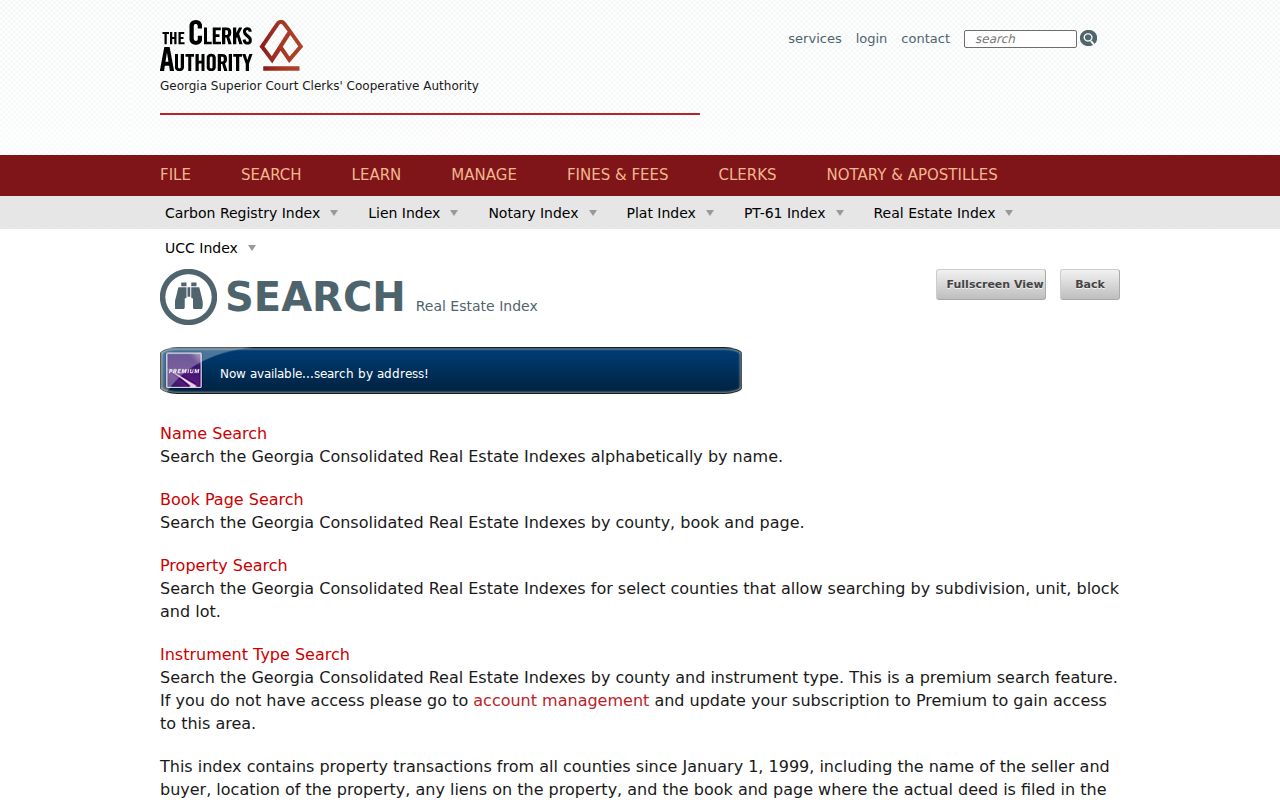
Catoosa County Deeds Online From 1999
GSCCCA describes its statewide real-estate index as beginning January 1, 1999, with transactions from 1993 through 1998 being added over time. Treat that as a boundary, not a guarantee. Some earlier transfers simply have not been indexed. If a chain breaks in those years, go to the Clerk's books directly.
The official custodian is the Clerk of Superior Court at 875 Lafayette Street in Ringgold. Do not confuse the two offices. The administrative County Clerk sits at 800 Lafayette Street. It handles different duties. Certified court and deed copies come from the Superior Court Clerk alone. The county's general GovQA intake is the wrong door for those requests.
Read the Catoosa Grantor-Grantee Trail
A chain gets built by matching the same people. It also leans on the same dates and the same piece of land. The name index works best with a starting point. The current owner of record from qPublic gives you the first grantee. Work backward from that point. Resist the urge to search every familiar surname at once.
- Find the present owner's acquisition deed with that owner listed as grantee.
- Copy the grantor, recording date, instrument type, and book/page.
- Search that grantor as an earlier grantee, then compare the parcel or legal description.
- Repeat until the online coverage boundary, then continue with the Clerk's deed books or microfilm.
- Grantor
- The party conveying an interest.
- Grantee
- The party receiving the interest.
- Chain of title
- The ordered set of transfers tied to the same land.
- Book/Page
- The traditional coordinates for a recorded instrument; newer results may also carry an instrument identifier.
A shared name proves little on its own. Before adding any deed to a chain, compare the subdivision and lot, the metes-and-bounds description, adjacent owners, acreage, and prior book/page references.
PT-61 and Book/Page Pin Down a Catoosa Transfer
Two different records pin down a Catoosa transfer. The PT-61 transfer-tax record can supply consideration or sales-price context. Book/page points to the recorded instrument itself. A consideration amount is never the assessor's current market value, and the recording date may not match the date the parties signed or closed. A deed search often starts from a parcel card. Carry the parcel identifier into the deed search. Let the recorded legal description control the match, though. Catoosa's parcel references are alphanumeric, and guessing at their structure leads nowhere.
Book R Preserves 1920-1921 Catoosa Deeds
The Georgia Archives Virtual Vault holds Catoosa County Deed Book R, a 309-image microfilm run covering 1920 and 1921. Its catalog note warns that there is no index. A researcher may have to browse page images or arrive carrying a book/page citation found elsewhere. That is the reality of older deed records. Access can be digital even when search is not. Page-by-page inspection, marginal references, prior-deed citations, and legal descriptions matter far more than a modern name box.
The 1864 Fire Did Not Erase Catoosa's Trail
Catoosa's first courthouse went up in 1856. Digital Library of Georgia history records that an 1864 fire attempt was stopped from destroying the building, thanks to its Masonic third story. For deed researchers, the story carries a lesson. Never assume Civil War-era courthouse danger wiped out a county's records wholesale. Survival still does not mean a seamless online index, though. Older deed books, plats, court minutes, and local-history sources often need reconciliation by hand. The Catoosa County Library's Mildred E. Ward Special Collections Room holds maps, clippings, microfilm, family files, and obituary cards. Special-collections requests may take up to a month.
Use Catoosa Filing Alerts for New Deeds
The Georgia Filing Activity Notification System sends alerts when transmitted index data matches criteria you choose. That makes it a strong tool for catching a later filing tied to a name or property interest. It helps especially given current worry about seller-impersonation deed fraud. Keep its limits in mind. FANS is not a title search, and it does not guarantee complete or current filings. Treat every alert as a prompt. Inspect the GSCCCA entry and obtain the actual deed from the Clerk.
Obtain a Catoosa County Deed Copy
Start with any GSCCCA image you can pull online. Is the image missing, older than the online coverage, or in need of certification? The Clerk of Superior Court handles those requests. The office sits at 875 Lafayette Street, Ringgold, GA 30736. Include the names on the deed and the recording date. Add the instrument type and either the book/page or instrument number. The Clerk can confirm the current copy fee. It can also confirm the request methods it accepts, since no set charge is published.
Older research calls for other tools. The Clerk's deed books reach further back. The Georgia Archives Virtual Vault and the FamilySearch catalog also do. The Catoosa catalog also lists court minutes from 1834 through 1920 on three microfilm reels. Local maps and family files can untangle name or place puzzles. But the recorded deed and its legal description remain the evidence that counts.
Recorded, not guaranteed. Catoosa County deed records show filed instruments, not a title opinion; unrecorded interests and unresolved defects may still exist.