
Build a Catoosa Former-Owner Timeline
Build the timeline from the newest deed backward, one conveyance at a time. Give each entry its own columns. Record the date, grantor, grantee, deed type, book/page, and any legal land clue. Laid out that way, a missing link in the Catoosa County chain stands out. It no longer hides in a paragraph of notes.
| Transfer date | Grantor to grantee | Deed type | Book/Page |
|---|---|---|---|
| Newest filing | Prior owner to current owner | Read the instrument | Copy exactly |
| Earlier acquisition | Earlier grantor to that prior owner | Read the instrument | Copy exactly |
| Older book entry | Named parties in the deed book | Warranty, quitclaim, executor, or other | Book and page |
| Unresolved interval | Do not guess | Check probate, plat, and court sources | Record the gap |
Treat the table as a worksheet, not proof that every Catoosa conveyance is online. Pull the starting land from the current parcel card. Then use GSCCCA for recent transfers and the Clerk or archives for the older trail.
The Catoosa Online Chain Starts in 1999
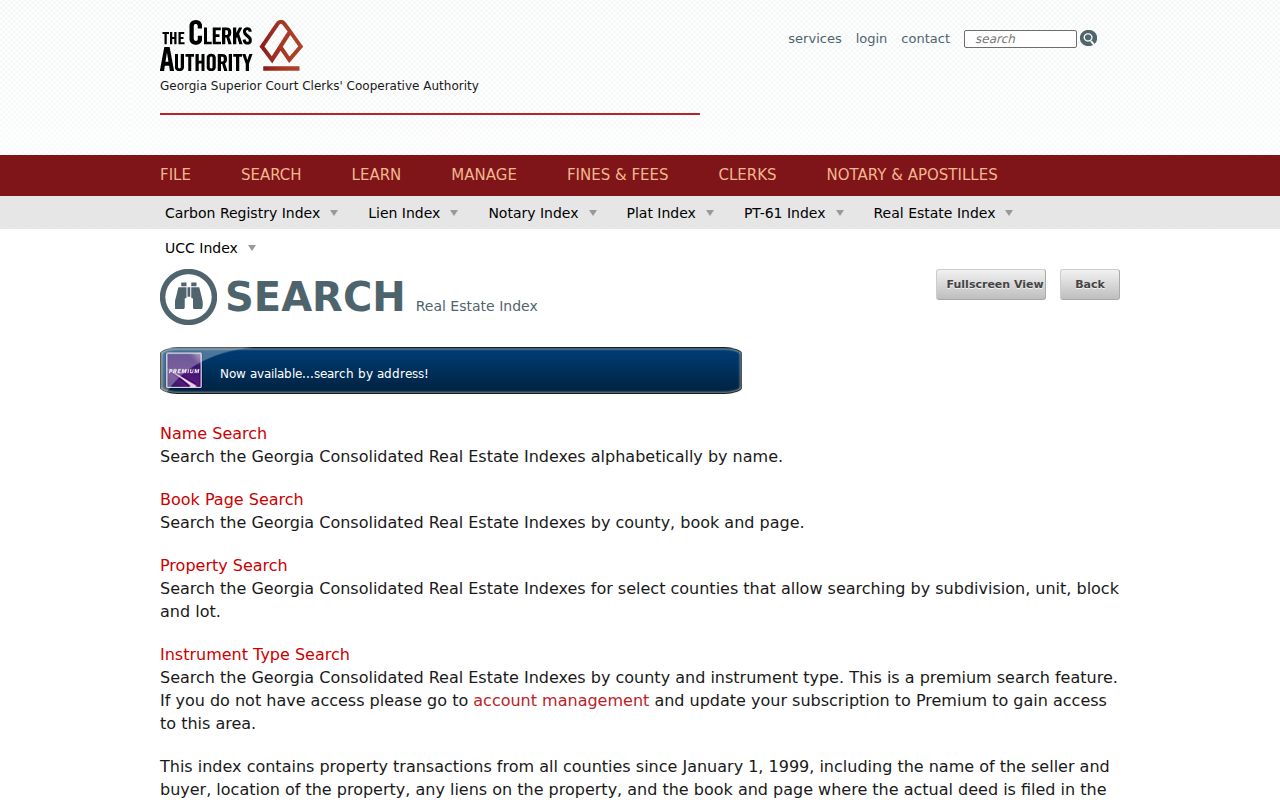
The GSCCCA real-estate index covers statewide transactions from January 1, 1999. Records from 1993 through 1998 are still being added. That date matters. Treat 1999 as the safe published starting point. It is not a promise that every expansion-year deed is searchable today.
Search a former Catoosa owner in both roles. As grantee the person received an interest; as grantor the person conveyed one. Apply county and date filters. Then compare legal-description clues and recording references before accepting a match.
Book R Opens a 1920-1921 Catoosa Window
The Georgia Archives Virtual Vault offers Catoosa County Deed Book R as a 309-image microfilm run. It covers 1920 and 1921. The catalog entry says "No index." That note changes the method. Arrive with a book/page citation when you can. Otherwise browse the images. Scan marginal notes, and compare names, roads, adjacent owners, acreage, and legal descriptions. One unindexed book this size shows something. Older former-owner research in Catoosa County can take far longer than a modern index search.
Older Catoosa Owners Live Beyond Deed Search
When GSCCCA coverage ends, the Clerk's deed books become the primary trail. Georgia Archives guidance adds county microfilm. The FamilySearch catalog for Catoosa lists court minutes from 1834 through 1920 on three 35mm reels. It also offers a land and property subject route.
The Mildred E. Ward Special Collections Room at the Catoosa County Library holds maps, clippings, microfilm, family files, obituary cards, and Cherokee material. Its Ancestry access works only on library computers. A special-collections request may take up to a month. These sources explain people and places, but a family file is not a deed.
Probate Can Repair a Broken Catoosa Chain
A death can interrupt the neat buyer-seller pattern. Search Catoosa probate material whenever a deed names an executor, administrator, estate, heir, or trustee. The same applies when a prior owner never conveyed the land in an ordinary sale.
Then return to recorded land instruments. Executor and administrator deeds may supply the next link. Wills, estate inventories, year's support, and court orders can explain who had authority and how land was distributed. Match the property description each time.
Name Variants Hide Catoosa Previous Owners
Indexes preserve exactly how a name was entered. Search initials, full names, spelling variants, former surnames when supported, and entity suffixes. Estate, trustee, and corporate ownership may take several searches. Ringgold may appear as Ringold in informal material, and Fort Oglethorpe may shrink to Ft. Oglethorpe. Place names drift too. A street or subdivision clue should lead back to a parcel ID, plat reference, or deed description, since a landmark name, postal city, or road-project list is never proof of title.
The 1864 Courthouse Fire Did Not End Catoosa Records
Catoosa's 1856 courthouse was set on fire in 1864. Digital Library of Georgia history says its Masonic third story reportedly stopped the building's destruction. That detail matters. It undercuts an easy but unsupported assumption. It assumes the county lost its entire early land trail. Surviving records can still sit unindexed or in odd places. Treat each gap as a routing problem. Check the Clerk and the deed books. Check plats, archives, court minutes, and probate material. Check tax digests and local collections before declaring a Catoosa County chain lost.
Walk a Catoosa Deed Chain Backward
Use the current owner only as a starting point. A parcel card may lag a fresh closing, so compare it with the latest recorded deed. Each grantor points to an earlier deed covering the same land.
- Find the newest acquisition deed with the current party as grantee.
- Copy the grantor, deed type, date, book/page, and legal description.
- Search that grantor as an earlier grantee and verify the same land.
- Repeat to the online cutoff, then continue in deed books and microfilm.
- Grantor / grantee
- The conveying and receiving parties.
- Chain of title
- The ordered transfers affecting the same land.
- Reverse index
- An index route organized from the receiving party.
- Legal description
- The land identity that survives street-address changes.
- Quitclaim / warranty
- Different conveyance forms with different stated assurances.
How Far Back Catoosa Ownership Records Go
Catoosa County was created in 1853. A parcel's earlier land history may still cross predecessor boundaries and other record sets. The online deed index supplies the modern layer. Clerk's books and archival microfilm reach deeper, while plats and court material can bridge changes in description. No single date guarantees a complete former-owner chain. Stop when the goal is met. Mark uncertainty rather than supplying an owner from a weak name match. For a single recorded instrument and copy route, consult the Catoosa County deed records guide.
Lawful use. Trace former owners for house history, estate work, or property diligence; never use a record trail to stalk, harass, or harm a person.