
Search Catoosa Property Records
The Catoosa Board of Assessors qPublic portal is the right first stop. An address or owner name there opens a parcel ID, an owner-of-record entry, mailing and physical addresses, acreage, class, taxing district, assessed value, and recent sale rows. Copy the exact parcel ID before moving on. That ID links the map and the tax account. It also ties to a zoning request and any later call to an office. Ownership itself gets confirmed through the Clerk of Superior Court. It also runs through the statewide GSCCCA real-estate index. The Tax Commissioner holds the bill, the payment history, the due date, delinquency, and any tax-sale status. Read the map for location and adjoining parcels. Treat it as context, never as a survey. Every source here has one narrow job. Using each for that job keeps the search straight.
- Find the assessment parcel by address, owner, or parcel number.
- Confirm the recorded transfer by grantor, grantee, or book and page.
- Open the Tax Commissioner account for bill and payment facts.
- View roads, city limits, and nearby tracts on the parcel map.
- Request certified or older records from the proper custodian.
Catoosa Property Records Offices
Three offices anchor the Catoosa County property records system. The Clerk of Superior Court records deeds, security deeds, liens, releases, plats, lis pendens, and related instruments. The Board of Tax Assessors keeps the ownership, appraisal, and mapping data. That data feeds the tax digest. The Tax Commissioner issues bills and records payments. The office also accepts homestead applications and handles delinquency and tax-sale material. Administrative records requests go elsewhere, to the County Clerk through GovQA.
Catoosa Clerk of Superior Court
875 Lafayette Street
Ringgold, GA 30736
706-935-4231
Catoosa Board of Tax Assessors
798 Lafayette Street
Ringgold, GA 30736
706-965-3772
Catoosa qPublic Parcel Facts
The assessor counts more than 28,000 real-estate parcels and about 6,900 personal-property or mobile-home records. A typical qPublic result splits Owner, Mailing Address, and Physical Address into separate fields. That split matters. Tax mail can go to an address outside the county. The land itself keeps a Catoosa situs. The Catoosa qPublic entry is the official starting point for assessment and map data.
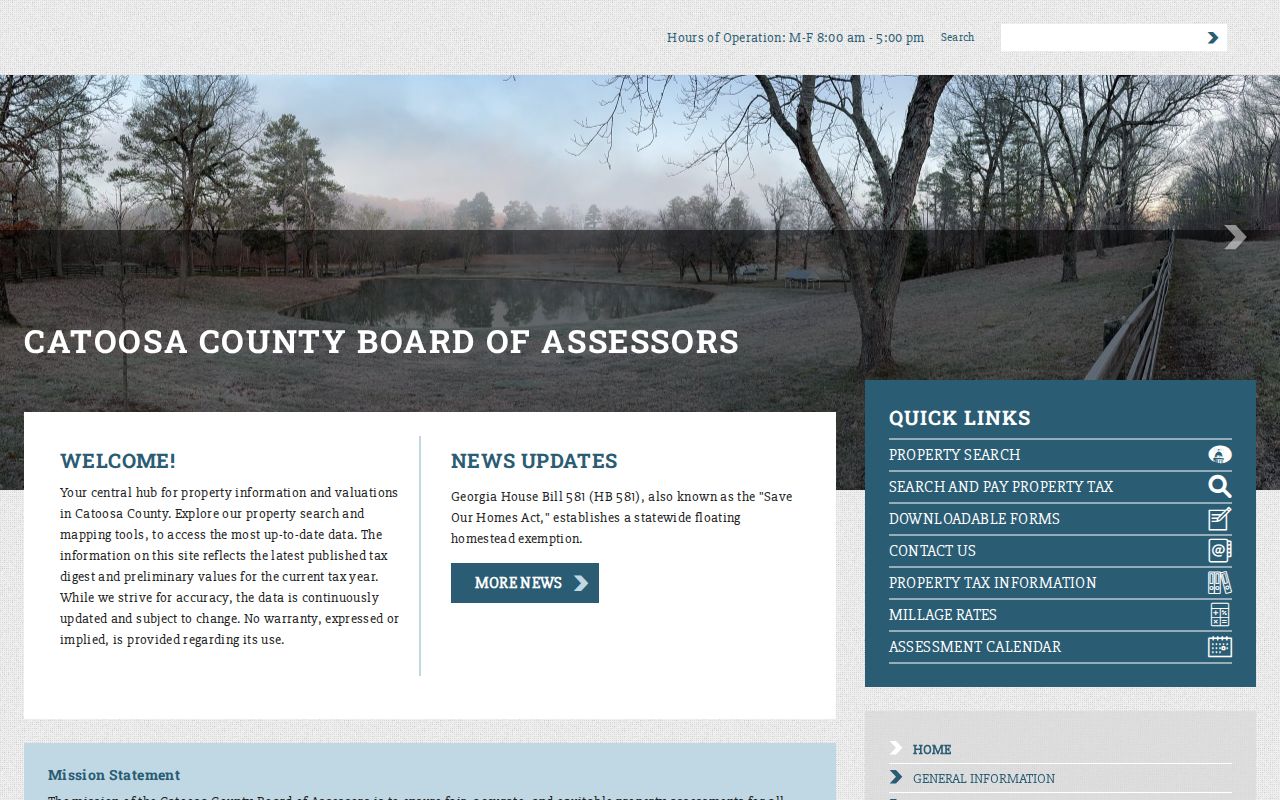
The portal sometimes shows a Cloudflare challenge. If it appears, use the assessor hub instead or contact the office with the address and parcel ID in hand.
Catoosa Parcel IDs Connect Records
Catoosa parcel identifiers can mix letters with leading zeros. One map sample displays 0021D043, and a tax statement example also carries a map code, P2888. Neither example works as a prefix guide. Copy every character exactly as shown, and keep both identifiers when an office lists both.
Useful property terms
- Parcel
- A tax-and-map unit maintained by the assessor.
- Grantor and grantee
- The party transferring an interest and the party receiving it.
- Plat
- A recorded drawing of lots, roads, and related survey information.
- Assessment
- The value used in Georgia's property-tax process.
The parcel number keeps a search pinned to one tract when street labels, owner names, or ZIP cities shift. A deed's legal description still controls over any map label.
Catoosa Property Record Types
Each type of Catoosa County property record answers a different question. Deeds show recorded conveyances. Security deeds and liens flag recorded claims. Assessments describe the tax parcel and its value. Bills show what is due and what was paid. Plats and GIS maps give spatial clues, while permit and zoning files reveal reviewed land-use or construction activity.
| Record Type | What It Documents | Kept By | Access |
|---|---|---|---|
| Deeds | Transfers and legal descriptions | Superior Court Clerk | GSCCCA and office |
| Security deeds and liens | Recorded claims and releases | Superior Court Clerk | GSCCCA and office |
| Assessment and tax | Value, exemptions, bill, payment | Assessors and Tax Commissioner | Separate official portals |
| Plats and parcels | Lots, map context, adjoining tracts | Clerk and assessor | Plat index and qPublic |
| Permits and zoning | Applications, inspections, land use | County or city office | Forms and records requests |
Reach for the recorded deed when the question is title history. Use the assessment entry to pin down the parcel and the owner listed for tax purposes. Consult the Catoosa property search steps when only an address or a name is known.
Catoosa Deeds Begin Online in 1999
The GSCCCA public real-estate index covers statewide transactions from January 1, 1999, and six earlier years, 1993 through 1998, are being added. Search modes include name, book/page, property, and instrument type. Results can lead to deeds, security deeds, assignments, releases, liens, plats, lis pendens, and PT-61 conveyance information. The GSCCCA search screen is the practical route into that recorded trail.
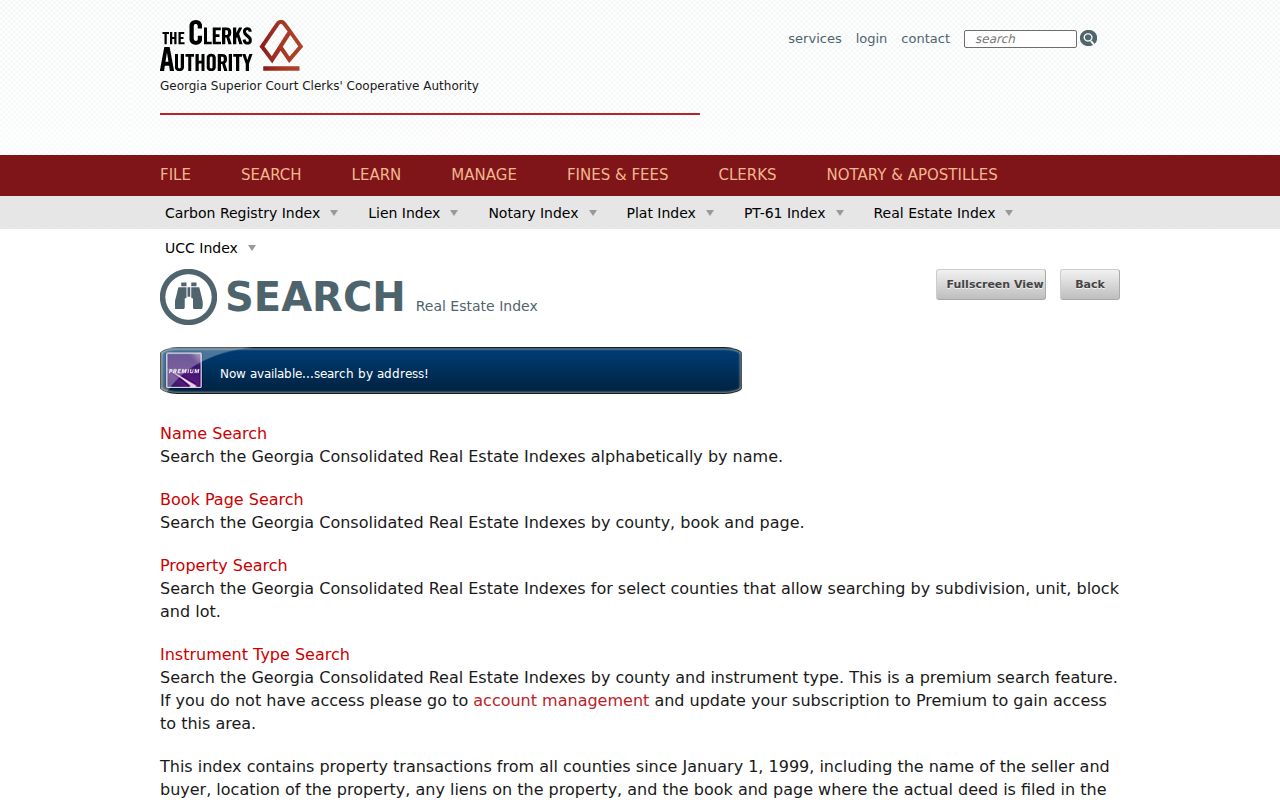
Start with the current owner's exact indexed name. Then save the recording date, party roles, instrument type, and book/page for each matching transfer you find.
Catoosa Value and Tax Split
Georgia generally assesses taxable property at 40 percent of fair market value. The assessor's number is not the last sale price. Neither figure alone predicts what the land would fetch today. A Catoosa tax bill can lay out fair-market value, assessed value, exemptions, taxable value, millage, gross and net tax, credits, and any delinquent amount.
Keep the notices straight. A Catoosa assessment notice is an estimate used in the tax process, not the property-tax bill.
Taxes are generally due December 20, per the Tax Commissioner. Homestead applications go to that same office, which lists regular, veteran, senior, and local exemption categories. Check filing requirements against the current official instructions.
Catoosa Maps Are Not Surveys
The qPublic map can display the selected parcel. It can also show roads, aerial context, parcel labels, and the Ringgold or Fort Oglethorpe city limits. The county's own output states plainly that it is not for legal documents. Parcel lines help frame a question. They do not prove a boundary. For lot-and-block land, find the recorded subdivision plat in the Clerk's plat docket. For metes-and-bounds land, read the calls in the deed along with its source references. When a line is disputed or construction-sensitive, a licensed survey is the proper evidence.
Older Catoosa Deed Books Survive
Online indexes stop somewhere. In Catoosa County, older deeds live on. The Georgia Archives Virtual Vault images Catoosa Deed Book R, covering 1920 and 1921. Its catalog lists 309 images and warns that the volume has no index. That means page-by-page browsing, guided by names, legal descriptions, adjoining owners, and book sequence.
Courthouse history explains the gaps. Federal troops set the 1856 courthouse on fire in 1864. A Masonic third story reportedly helped save the building. Still, access depends on the volume that actually survives. The Clerk, the Archives, the FamilySearch catalog, library special collections, and the county historical society form the fallback chain.
Permits Follow Catoosa Jurisdiction
Jurisdiction decides where a Catoosa County permit file lives. County Planning and Zoning handles building, zoning, subdivision, transportation, inspection, and code-enforcement applications in unincorporated areas. Ringgold and Fort Oglethorpe keep their own. A postal city name settles nothing. Confirm the parcel against the county map and the current city boundary first.
Fort Oglethorpe also crosses into Walker County. Its mailing label cannot tell you which assessor or clerk holds the land record. Ringgold's ZIP geography reaches past the incorporated line too. Match the parcel before filing a permit request.
Catoosa FANS Filing Alerts
Georgia's Filing Activity Notification System, called FANS, sends an alert when transmitted index activity matches a registered name or property-related criterion. Users set their own criteria. It is forward-looking only. Coverage is not guaranteed complete or current.
An alert never proves fraud, title, or validity. Open the underlying index entry, compare its parties and legal description, and contact the Clerk when a filing looks unfamiliar. Georgia's Attorney General also publishes title-theft and unsolicited real-estate safeguards.
Catoosa Records Beyond the Web
Portals hit walls sometimes. The office counter is the backup. The Clerk handles recorded instruments and certifications. The assessor covers parcel-card and mapping help. The Tax Commissioner answers bill and payment questions. County administrative files now route through the GovQA request platform announced in December 2025.
The Georgia Open Records Act generally requires an initial agency response within three business days. Reasonable search and redaction time may be charged, along with ten cents per paper page. An agency need not create a new report. Name the address, parcel ID, owner, record type, and date range so the custodian can locate an existing record.
Catoosa Liens and Releases
A deed tells only part of the story. Liens travel with Catoosa County land too. The GSCCCA lien and deed dockets list security deeds, assignments, cancellations, mechanic's liens, tax liens, lis pendens notices, and releases. A security deed is Georgia's standard instrument securing a real-estate loan. An assignment transfers that secured interest, while a cancellation or release shows a claim was satisfied. Search current and former owner names. Compare each hit against the parcel's legal description and recording dates.
A name match is weak evidence. Common surnames, business entities, and countywide filings generate noise. Book and page, instrument type, subdivision lot, and property description narrow the trail. A lis pendens notice never states the final outcome. The Catoosa court portal searches Superior and State Court matters by party name or case number, but the clerk's file holds the pleadings and disposition.
When a release seems absent, ask the Clerk to check the direct and reverse indexes and any linked recording reference. A search shows what entered the public record. Deciding how an instrument affects title takes legal advice.
Catoosa Library Search Clues
The Mildred E. Ward Special Collections Room rewards a visit. At the Catoosa County Library, its shelves hold maps, newspaper microfilm, clippings, family files, obituary cards, Cherokee material, and Ancestry Library Edition on the library's computers. Requests may take up to a month. Ask one focused question. Include a surname, road or community, approximate date, and any deed-book or parcel clue already found.
Old newspapers link names to events. A sale notice, estate matter, local business, or road description can sit beside an old owner name. The Georgia Historic Newspapers collection lists the Weekly Catoosa Courier of Ringgold, including an issue from May 1872. That is a lead, not a deed. Verify each transfer in the Clerk's books, archived images, or later index.
The Catoosa County Historical Society keeps a museum and reference library too. Family histories and local artifacts fill it. Use those collections to resolve changing place names and community references, then return to the official land record.
Limits of Catoosa Property Records
Catoosa County property records carry administrative facts. Facts from recording, appraisal, taxation, mapping, and land-use administration fill them: the assessed owner, recorded grantee, parcel value, filed lien, plat, and permit. They cannot show who occupies a home, clear a title, set a surveyed line, or replace a market appraisal.
Recent transfers deserve a second look. Office systems update on different schedules, so save the date of each search. Confirm the newest deed directly with the Clerk.
Lawful use. Use Catoosa County property records for due diligence, boundary research, tax review, history, and civic transparency. Never use owner data to stalk, harass, or harm anyone.